
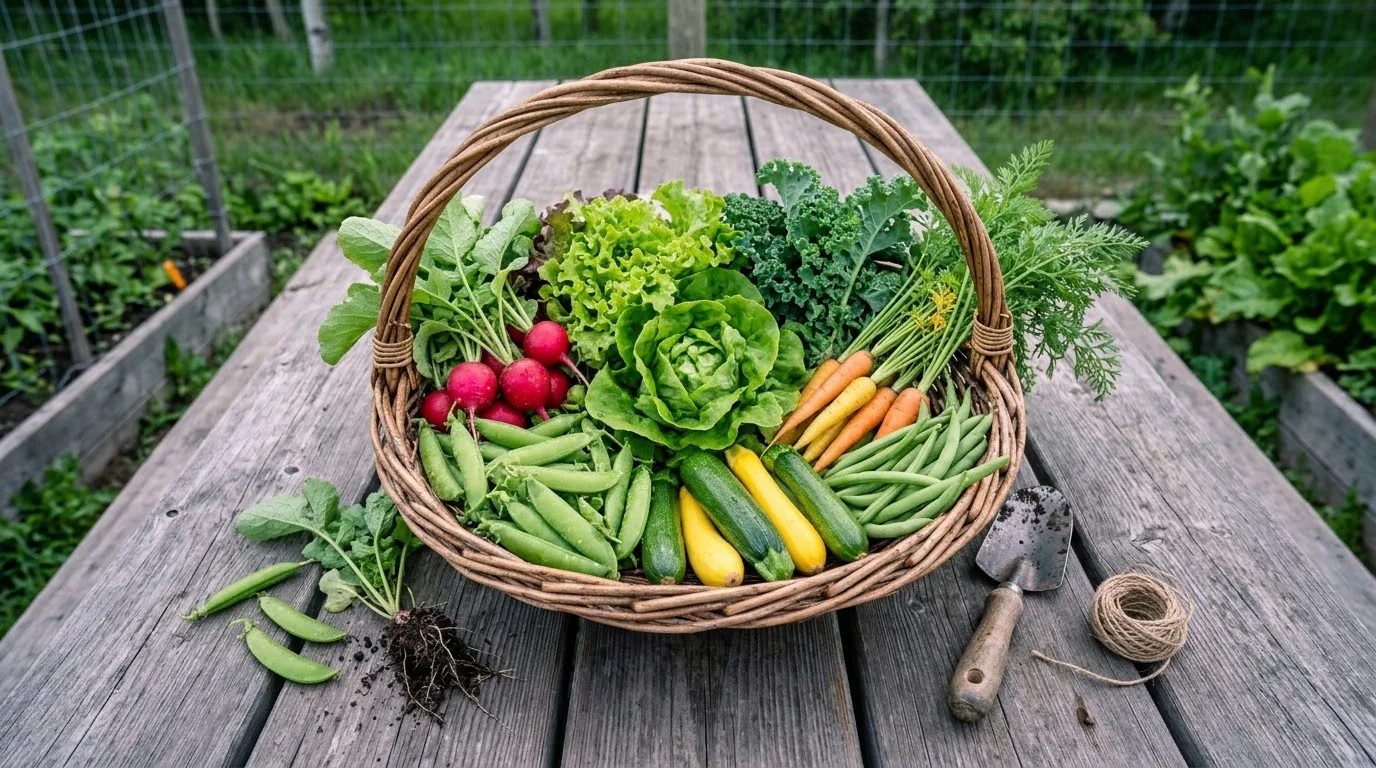
25 Fast-Maturing Vegetables for a Short Growing Season
When your frost-free season is 90 to 110 days, or even less, the number printed on a seed packet matters more than the picture. A carrot that needs 75 days is fine. A squash that needs 110 days probably is not. This list collects 25 vegetables, each with a variety that finishes well inside a short northern season.
How to read “days to maturity”
Days to maturity is the seed company’s estimate of time to first harvest. Two details trip people up:
- For direct-sown crops (radishes, carrots, beans, peas, greens) the count starts when the seed goes in the ground.
- For transplanted crops (tomatoes, peppers, cabbage, squash started indoors) the count usually starts on the day you set the plant outside. Add the weeks spent indoors on top.
Cool summers also stretch these numbers. If your nights stay cool, treat the days as a minimum and leave a buffer of two to three weeks before your average first fall frost.
25 fast vegetables for a short season
Sorted from fastest to slowest. Days to maturity are as listed by Northern Homestead, a short-season garden in northern Canada, except where noted.
| # | Vegetable | Variety | Days | How to plant | Note |
|---|---|---|---|---|---|
| 1 | Radish | French Breakfast | 25 | Direct sow | Sow every 2 weeks from early spring |
| 2 | Broccoli raab (rapini) | Sorento | 35 | Direct sow | Harvest before the buds open |
| 3 | Swiss chard | Bright Lights | 40 | Direct sow | Pick outer leaves all season |
| 4 | Tomato | Sub-Arctic Plenty | 42 | Transplant | See our zone 3 tomato guide |
| 5 | Lettuce | Black-Seeded Simpson | 45 | Direct sow or transplant | Loose-leaf types are fastest |
| 6 | Summer squash | Cocozelle | 45 | Transplant | Zucchini-type, very productive |
| 7 | Eggplant | Fairy Tale | 49 | Transplant | Small fruit; needs your warmest spot |
| 8 | Cauliflower | Early Snowball | 50 | Transplant | Start indoors 4–6 weeks early |
| 9 | Kale | Winter Red | 50 | Direct sow or transplant | Tolerates light frost |
| 10 | Kohlrabi | Kongo | 50 | Direct sow or transplant | Easy and quick |
| 11 | Peas | Tom Thumb | 50 | Direct sow | Very early, compact |
| 12 | Zucchini | Dark Star | 50 | Transplant | Good keeper |
| 13 | Spinach | Bloomsdale | 50 | Direct sow | Sow as soon as soil can be worked |
| 14 | Gai lan (Chinese broccoli) | Gai Lan | 50 | Direct sow or transplant | Several harvests per plant |
| 15 | Cucumber | Patio Snacker | 50 | Transplant | Compact; good in containers |
| 16 | Bush beans | Roma Gold | 55 | Direct sow | Reliable early yellow bean |
| 17 | Daikon radish | Daikon | 55 | Direct sow | Good for a late summer sowing |
| 18 | Beets | Bull’s Blood / Chioggia | 58 | Direct sow | Eat the leaves too |
| 19 | Broccoli | Calabrese | 60 | Transplant | Side shoots keep coming after the main head |
| 20 | Pepper | Doe Hill | 60 | Transplant | Small, sweet, early |
| 21 | Cabbage | Early Jersey Wakefield | 63 | Transplant | Start indoors early |
| 22 | Carrots | Scarlet Nantes | 65 | Direct sow | Sweet and dependable |
| 23 | Hot pepper | King of the North | 70 | Transplant | Bred for short seasons |
| 24 | Ground cherry | Aunt Molly’s | 70 | Transplant | Productive and stores well |
| 25 | Spaghetti squash | Tivoli | 74 | Transplant | Small, early winter squash |
Sub-Arctic Plenty days from Garden Betty.
The easiest wins
If you are new to short-season gardening, start with crops that like cool weather and grow fast from seed sown straight into the garden:
- Radishes, spinach, lettuce and peas can go in as soon as the soil can be worked in spring. A light frost will not hurt them.
- Swiss chard and kale keep producing from early summer until hard frost, so one planting feeds you for months.
- Bush beans and beets are reliable once the soil warms, and both are ready well before fall.
Crops that need a head start indoors
Warm-season crops like peppers, eggplant, tomatoes and most squash will not finish in time if you sow them outside. Start them indoors and set them out after your last spring frost, once nights are mild. Peppers and eggplant are the slowest to get going, so they need the earliest indoor start and the warmest spot in the garden.
Cabbage, broccoli and cauliflower handle cool weather well, but starting them indoors four to six weeks early gives you a harvest weeks sooner.
Tips to squeeze more out of a short season
- Sow in succession. Small sowings of radish, lettuce and spinach every two weeks give a steady harvest instead of one glut.
- Pick small varieties. Cherry tomatoes, small squash and compact cucumbers ripen faster than their large cousins.
- Warm the soil. Black plastic mulch or a cold frame warms the bed and gets transplants growing sooner.
- Use row covers. Lightweight fabric covers protect young plants from frost and wind at both ends of the season.
- Plant a fall crop. Radish, spinach, kale and daikon sown in mid to late summer mature in the cool weeks of fall.
Not sure how long your season is? Start with our guide to growing zones in Canada, then look up your local frost dates.
Keep reading
Frequently Asked Questions
What is the fastest vegetable to grow?
Radishes are the fastest common vegetable. Varieties like French Breakfast can be ready in about 25 days from sowing.
What vegetables grow well in a short growing season?
Cool-season crops such as radishes, lettuce, spinach, peas, kale, chard, beets and carrots do well. Warm-season crops like tomatoes, peppers and squash also work if you choose early varieties and start them indoors.
Does days to maturity start from seed or transplant?
For direct-sown crops it starts at sowing. For crops usually transplanted, like tomatoes and peppers, it normally starts on the day you plant them outside.
Can I grow peppers in a short season?
Yes. Start them indoors early, transplant after your last frost, and choose early varieties such as Doe Hill or King of the North, which mature in about 60 to 70 days from transplant.
2 Comments