How to Start Seeds Indoors in a Cold Climate
In a short-season climate, many of your best crops start life on a windowsill or a shelf in the basement. Peppers, tomatoes, onions and cabbage all need weeks of growth before it is warm enough outside, and starting them indoors is what turns a 100-day summer into a full harvest.
This guide covers when to start each crop, what you need, and how to grow short, sturdy seedlings instead of pale, floppy ones.
Step 1: Find your last frost date
Every indoor seed-starting date is counted back from your average last spring frost, or from the day you plan to transplant. Look up the date for your town before you buy a single seed. As examples, the University of Saskatchewan lists Saskatoon’s average last frost around mid-May and Meadow Lake’s in early June, while Northern Gardener puts much of Minnesota around May 10.
Remember that the average last frost is not a safe date: in about half of years, frost comes later. Tender crops go out one to two weeks after it.
Step 2: When to start each crop
| Crop | When to start indoors (mid-May last frost) | Goes outside |
|---|---|---|
| Onions, leeks, celery (from seed) | Before March 1 | Early to mid-May; tolerate light frost |
| Peppers | Early to mid-March | Late May to early June, after frost |
| Cabbage, broccoli, cauliflower | Early to mid-March | Mid-May; tolerate light frost |
| Lettuce (for an early start) | Early to mid-March | Early to mid-May |
| Tomatoes | Early April (about 6 weeks before transplant) | Late May to early June |
| Squash, cucumbers, melons (optional) | Late April to early May, in large pots | Early June |
Timing based on Northern Gardener and the USask tomato guide. If your last frost is in late May or June, shift every date one to three weeks later.
Many crops do better sown straight into the garden and are not worth starting indoors: carrots, beets, radishes, peas, beans and potatoes. Squash and cucumbers dislike root disturbance, so if you start them inside, give them their own large pots and only a few weeks’ head start.
Step 3: What you need
- Seed-starting mix. A light, soilless mix of peat or coir with perlite or vermiculite. Garden soil is too heavy and can carry disease.
- Containers with drainage holes. Cell trays, small pots or recycled containers all work.
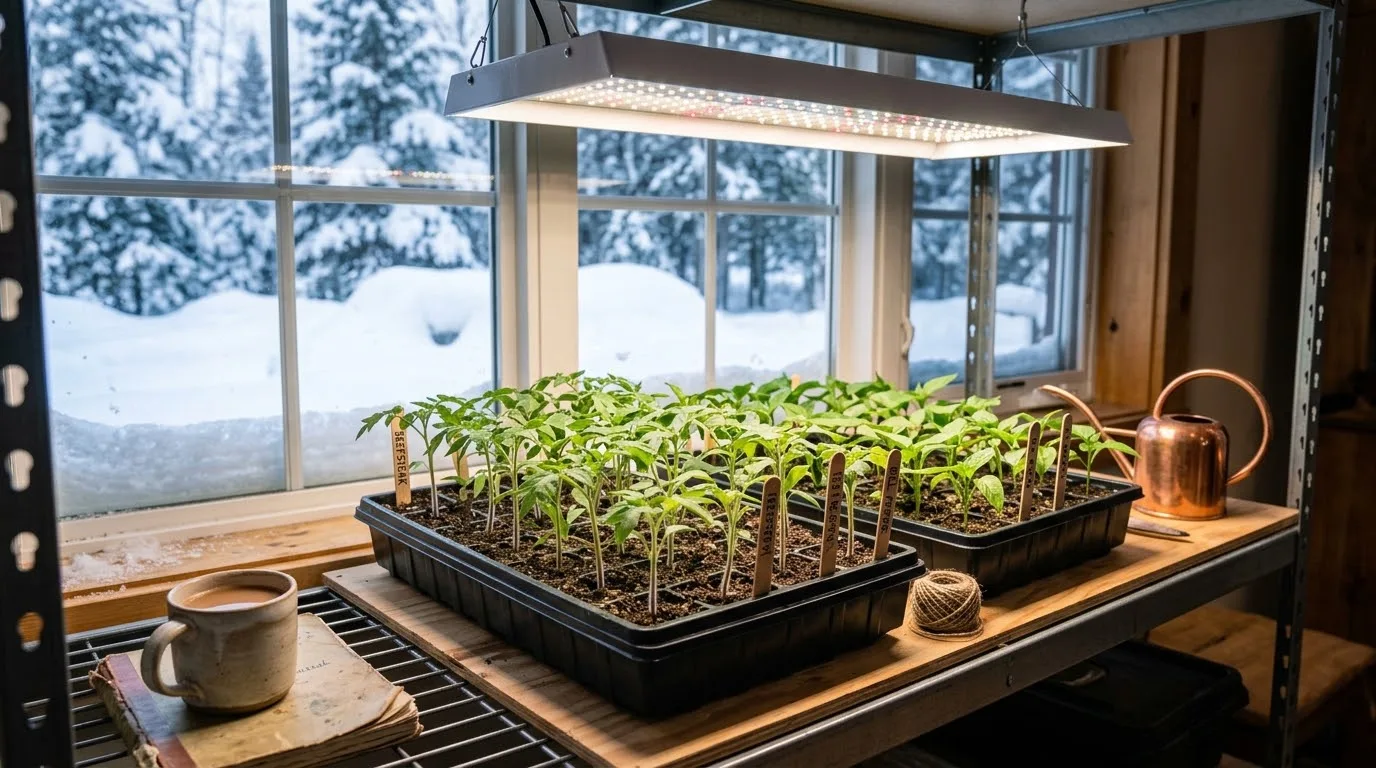
- A light source. In a northern spring, even a south window rarely gives enough light. A simple LED grow light hung a few centimetres above the seedlings is the single biggest upgrade most gardeners can make.
- A seedling heat mat (optional but helpful). Tomato seeds germinate in about a week when the mix is 24 to 32°C. A cool basement can be well below that.
- A small fan. Moving air builds thicker stems and helps prevent damping-off disease.
Step 4: Sow and germinate
- Moisten the mix before filling your containers. It should feel like a wrung-out sponge.
- Sow seeds at the depth on the packet. Tomatoes go about 0.5 cm deep; very small seeds like lettuce barely need covering.
- Cover the tray with a clear lid or plastic to hold humidity, and set it on the heat mat.
- Check daily. As soon as the first seedlings appear, remove the cover and turn on the lights.
Step 5: Grow sturdy seedlings
- Light, and lots of it. Keep lights close and on for about 14 to 16 hours a day. Leggy, stretched seedlings almost always mean too little light.
- Air movement. USask recommends a fan or brushing the tops of the seedlings by hand daily to thicken the stems.
- Feed lightly. Start feeding once the first true leaves appear, with a balanced water-soluble fertilizer at the label rate.
- Water from below. Let the mix dry slightly on top between waterings. Soggy mix invites disease.
- Pot up. Move seedlings to bigger pots when roots fill their cells, especially tomatoes and peppers that are inside for many weeks.
The goal, in USask’s words, is a short, stocky, dark green plant with a healthy root system that is not yet flowering.
Step 6: Harden off before planting out
Seedlings raised indoors have never felt wind, sun or cold nights. Over about a week, set them outside in a sheltered spot for a few hours, then a little longer each day, and bring them in on cold nights. Skipping this step can scorch or stall plants for weeks.
Common problems
- Tall, floppy seedlings: not enough light, or seeds started too early.
- Seedlings collapse at the soil line: damping-off. Use fresh mix, clean containers, less water and more air movement.
- Yellow lower leaves: often hungry seedlings in a soilless mix. Begin light feeding.
- Nothing germinates: mix too cold or too dry, or old seed.
Keep reading
- When to plant tomatoes in zone 3
- 25 fast-maturing vegetables for a short growing season
- What is my growing zone in Canada?
Frequently Asked Questions
When should I start seeds indoors in Canada?
It depends on your last frost date and the crop. With a mid-May last frost, start onions before March, peppers and cabbage in early to mid-March, and tomatoes in early April. Shift later if your last frost is in late May or June.
Do I need a grow light to start seeds?
In northern climates, usually yes. Spring windows rarely give enough light, and seedlings stretch and flop. A simple LED grow light hung a few centimetres above the plants makes a big difference.
How warm should the soil be to germinate tomato seeds?
Tomato seeds germinate in about a week when the mix is 24 to 32°C. A seedling heat mat helps in a cool house or basement.
Which vegetables should not be started indoors?
Root crops like carrots, beets and radishes, plus peas, beans and potatoes, do better sown directly in the garden.
How long should I harden off seedlings?
About a week. Start with a few hours outside in a sheltered spot and increase the time each day before planting out.
3 Comments