Alberta Vegetable Planting Calendar (Edmonton, Calgary, Red Deer)
Alberta gardens work with one of the shortest and most variable seasons in southern Canada. Edmonton averages about 123 frost-free days, the Calgary area closer to 100, and Fort McMurray around 70. That spread is why a single provincial planting date does not work.
This calendar lists average frost dates for Alberta cities, then turns them into suggested dates for starting seeds indoors, sowing outdoors and transplanting.
The short answer
- Most of Alberta sees its average last spring frost between mid- and late May, and the first fall frost in early to mid-September.
- Cool crops like peas, spinach and carrots can go in during early to mid-May; tomatoes, peppers and squash wait until late May or early June.
- Start tomatoes indoors in mid-April and peppers in late March to early April.
Average frost dates in Alberta
| Location (climate station) | Average last spring frost | Average first fall frost | Frost-free days |
|---|---|---|---|
| Edmonton (Edmonton City Centre) | May 15 | Sep 16 | 123 |
| Calgary area (Madden) | May 29 | Sep 6 | 99 |
| Red Deer | May 24 | Sep 10 | 108 |
| Grande Prairie | May 22 | Sep 6 | 106 |
| Lethbridge | May 25 | Sep 11 | 108 |
| Medicine Hat | May 18 | Sep 14 | 118 |
| Fort McMurray | Jun 15 | Aug 26 | 71 |
Frost dates from The Old Farmer’s Almanac (Environment Canada 1981–2010 normals, 33% probability threshold). The station used is named where it is outside the city. Full list for other cities: average frost dates for Canadian cities.
Alberta planting calendar
Suggested dates for four Alberta centres, based on the frost dates above:
| Task | Edmonton | Calgary area | Red Deer | Grande Prairie |
|---|---|---|---|---|
| Start onions and leeks indoors | Mar 20 | Apr 3 | Mar 29 | Mar 27 |
| Start peppers indoors | Mar 30 | Apr 13 | Apr 8 | Apr 6 |
| Start broccoli and cabbage indoors | Apr 7 | Apr 21 | Apr 16 | Apr 14 |
| Start tomatoes indoors | Apr 13 | Apr 27 | Apr 22 | Apr 20 |
| Sow peas, spinach, lettuce, radishes outdoors (soil workable, ~10°C for peas) | May 1 | May 15 | May 10 | May 8 |
| Sow carrots and beets outdoors | May 5 | May 19 | May 14 | May 12 |
| Plant potatoes (soil above ~7°C) | May 15 | May 29 | May 24 | May 22 |
| Transplant broccoli and cabbage (nights above −2°C) | May 18 | Jun 1 | May 27 | May 25 |
| Sow beans (soil at least 15°C) | May 22 | Jun 5 | May 31 | May 29 |
| Transplant tomatoes and peppers | May 25 | Jun 8 | Jun 3 | Jun 1 |
| Transplant or sow cucumbers, squash, pumpkins (days and nights 18°C+) | May 29 | Jun 12 | Jun 7 | Jun 5 |
| Last sowing of bush beans for a fall crop | Jul 18 | Jul 8 | Jul 12 | Jul 8 |
| Last sowing of spinach and leaf lettuce | Aug 2 | Jul 23 | Jul 27 | Jul 23 |
| Last sowing of radishes | Aug 17 | Aug 7 | Aug 11 | Aug 7 |
How these dates were worked out
Each date is counted from the local average frost dates above, using timing from the University of Saskatchewan Gardenline vegetable guides, which are written for prairie conditions:
- Onions and leeks are started indoors at least 8 weeks before the last frost; peppers about 8 weeks and tomatoes about 6 weeks before they go outside; broccoli and cabbage 5 to 6 weeks before.
- Peas, carrots and beets are sown 1 to 2 weeks before the last frost, once the soil is workable (peas want about 10°C).
- Potatoes go in when the soil passes about 7°C, usually around the last frost.
- Broccoli and cabbage transplants go out when nights stay above about −2°C.
- Beans are sown on or after the last frost, once the soil reaches about 15°C.
- Tomatoes and peppers go out 1 to 2 weeks after the last frost; cucumbers, squash and pumpkins about 2 weeks after, when days and nights reach about 18°C.
- Fall sowings are counted back from the first fall frost using typical days to maturity: about 45 to 65 days for bush beans, 35 to 45 for spinach and under a month for radishes (University of Minnesota Extension).
Treat every date as a starting point. Check the soil, watch the 7-day forecast, and move tender plants out later in a cold spring. Hardening off for about a week first is essential; see how to harden off seedlings.
Fall planting: garlic
Garlic is planted in fall, between late August and early October and up to about three weeks before the ground freezes, then mulched with 10 to 15 cm of straw. Details in when to plant garlic in Canada.
Tips for Alberta gardens
- Expect late frosts. A frost in early June is common enough that tender transplants should always have a cover ready.
- Use the warm spots. South-facing walls and city yards can gain several days at each end of the season.
- Choose short-season varieties. Tomatoes and peppers that finish in about 70 days or less are the safest bet. See tomatoes for zone 3.
- Warm the soil with plastic for a week or two before planting heat-loving crops: how to warm soil in spring.
Planning next season? Save this guide to your Pinterest board so it is there when you need it.
Gear that helps
- Seed starting trays with humidity domes: Domes hold moisture until seeds sprout; pick trays with drainage holes.
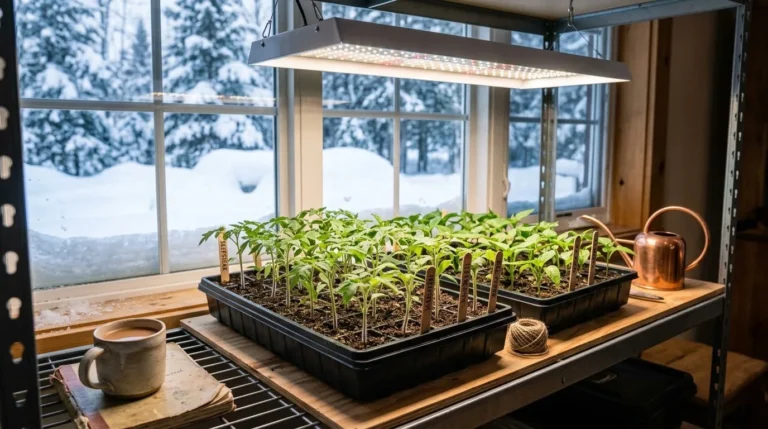
- LED grow light for seedlings: A window alone is too dim in a northern March or April. Keep the light a few centimetres above the plants.
- Frost cloth plant covers: Gives a few degrees of protection on cold spring and fall nights. Remove or vent it on warm days.
- Soil thermometer: Soil temperature, not the calendar, tells you when seeds will actually sprout.
As an Amazon Associate, Short Season Grower earns from qualifying purchases. Links open Amazon search results so you can compare brands, sizes and prices.
Frequently Asked Questions
When should I plant my garden in Edmonton?
With an average last frost around May 15, sow cool crops like peas and spinach in early May and transplant tomatoes and peppers around May 25, once nights stay mild.
When should I plant tomatoes in Calgary?
Using the Madden station average last frost of May 29, transplant tomatoes around June 8. City gardens often warm up a little earlier. Start seeds indoors in late April.
When do I start seeds indoors in Alberta?
For Edmonton, start onions around March 20, peppers in late March, broccoli and cabbage in early April and tomatoes in mid-April. Shift later for colder areas.
How long is the growing season in Alberta?
Roughly 100 to 125 frost-free days in the south and central parts of the province, and about 70 in Fort McMurray.