Saskatchewan Vegetable Planting Calendar (Saskatoon, Regina and More)
Saskatchewan gardeners plan around a frost-free season of roughly 90 to 125 days, depending on where they live. Saskatoon sits near the long end; Prince Albert and the north are much shorter.
The short answer
- Saskatoon’s average last spring frost is around May 15; most other towns are later, into late May or early June.
- Sow peas, spinach, carrots and beets in early to mid-May; transplant tomatoes and peppers in late May or early June.
- The University of Saskatchewan advises choosing tomatoes that ripen in about 70 days or less and peppers in about 75 days or less.
Average frost dates in Saskatchewan
| Location (climate station) | Average last spring frost | Average first fall frost | Frost-free days |
|---|---|---|---|
| Saskatoon (Saskatoon Water TP) | May 15 | Sep 19 | 126 |
| Regina area (Cupar) | Jun 1 | Sep 1 | 91 |
| Swift Current | May 23 | Sep 13 | 112 |
| Prince Albert | Jun 7 | Sep 4 | 88 |
| Moose Jaw | May 24 | Sep 12 | 110 |
| Yorkton | May 26 | Sep 10 | 106 |
| North Battleford | May 26 | Sep 12 | 108 |
| La Ronge | Jun 3 | Sep 4 | 92 |
Frost dates from The Old Farmer’s Almanac (Environment Canada 1981–2010 normals, 33% probability threshold). The station used is named where it is outside the city. Full list for other cities: average frost dates for Canadian cities.
Saskatchewan planting calendar
| Task | Saskatoon | Regina area | Swift Current | Prince Albert |
|---|---|---|---|---|
| Start onions and leeks indoors | Mar 20 | Apr 6 | Mar 28 | Apr 12 |
| Start peppers indoors | Mar 30 | Apr 16 | Apr 7 | Apr 22 |
| Start broccoli and cabbage indoors | Apr 7 | Apr 24 | Apr 15 | Apr 30 |
| Start tomatoes indoors | Apr 13 | Apr 30 | Apr 21 | May 6 |
| Sow peas, spinach, lettuce, radishes outdoors (soil workable, ~10°C for peas) | May 1 | May 18 | May 9 | May 24 |
| Sow carrots and beets outdoors | May 5 | May 22 | May 13 | May 28 |
| Plant potatoes (soil above ~7°C) | May 15 | Jun 1 | May 23 | Jun 7 |
| Transplant broccoli and cabbage (nights above −2°C) | May 18 | Jun 4 | May 26 | Jun 10 |
| Sow beans (soil at least 15°C) | May 22 | Jun 8 | May 30 | Jun 14 |
| Transplant tomatoes and peppers | May 25 | Jun 11 | Jun 2 | Jun 17 |
| Transplant or sow cucumbers, squash, pumpkins (days and nights 18°C+) | May 29 | Jun 15 | Jun 6 | Jun 21 |
| Last sowing of bush beans for a fall crop | Jul 21 | Jul 3 | Jul 15 | Jul 6 |
| Last sowing of spinach and leaf lettuce | Aug 5 | Jul 18 | Jul 30 | Jul 21 |
| Last sowing of radishes | Aug 20 | Aug 2 | Aug 14 | Aug 5 |
How these dates were worked out
Each date is counted from the local average frost dates above, using timing from the University of Saskatchewan Gardenline vegetable guides, which are written for prairie conditions:
- Onions and leeks are started indoors at least 8 weeks before the last frost; peppers about 8 weeks and tomatoes about 6 weeks before they go outside; broccoli and cabbage 5 to 6 weeks before.
- Peas, carrots and beets are sown 1 to 2 weeks before the last frost, once the soil is workable (peas want about 10°C).
- Potatoes go in when the soil passes about 7°C, usually around the last frost.
- Broccoli and cabbage transplants go out when nights stay above about −2°C.
- Beans are sown on or after the last frost, once the soil reaches about 15°C.
- Tomatoes and peppers go out 1 to 2 weeks after the last frost; cucumbers, squash and pumpkins about 2 weeks after, when days and nights reach about 18°C.
- Fall sowings are counted back from the first fall frost using typical days to maturity: about 45 to 65 days for bush beans, 35 to 45 for spinach and under a month for radishes (University of Minnesota Extension).
Treat every date as a starting point. Check the soil, watch the 7-day forecast, and move tender plants out later in a cold spring. Hardening off for about a week first is essential; see how to harden off seedlings.
Fall planting: garlic
Garlic is planted in fall, between late August and early October and up to about three weeks before the ground freezes, then mulched with 10 to 15 cm of straw. Details in when to plant garlic in Canada.
Tips for Saskatchewan gardens
- Watch for June frost. USask lists Meadow Lake’s average last frost around June 5 to 7, a reminder that the north runs weeks behind Saskatoon.
- Grow short-season varieties and start heat-lovers indoors.
- Plant onion sets after caragana blooms, a local cue USask uses to avoid peak onion maggot activity.
- Carrots can stay in the ground until the soil freezes, and a light frost sweetens them: growing carrots in a cold climate.
Gear that helps
- Seed starting trays with humidity domes: Domes hold moisture until seeds sprout; pick trays with drainage holes.
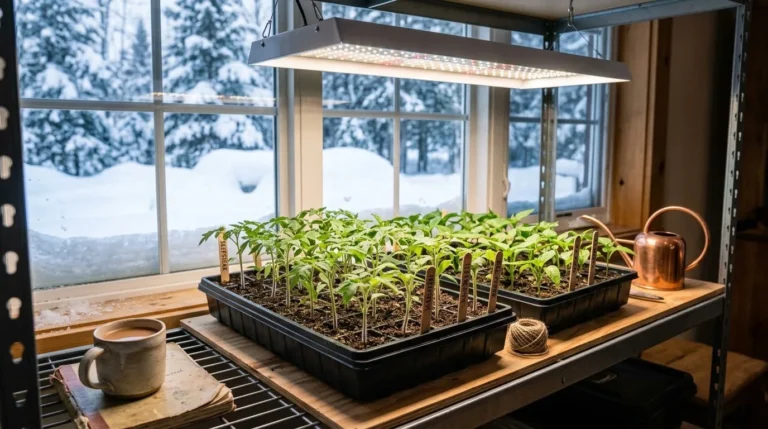
- LED grow light for seedlings: A window alone is too dim in a northern March or April. Keep the light a few centimetres above the plants.
- Frost cloth plant covers: Gives a few degrees of protection on cold spring and fall nights. Remove or vent it on warm days.
- Soil thermometer: Soil temperature, not the calendar, tells you when seeds will actually sprout.
As an Amazon Associate, Short Season Grower earns from qualifying purchases. Links open Amazon search results so you can compare brands, sizes and prices.
Frequently Asked Questions
When is the last frost in Saskatoon?
The average last spring frost in Saskatoon is around May 13 to 15, with the first fall frost around mid- to late September.
When should I plant tomatoes in Saskatchewan?
Transplant one to two weeks after your average last frost. In Saskatoon that is around May 25; in Regina-area and northern gardens, early to mid-June.
When do I start seeds indoors in Saskatchewan?
For Saskatoon, start onions around March 20, peppers in late March, broccoli and cabbage in early April and tomatoes in mid-April, as USask recommends.
What vegetables grow best in Saskatchewan?
Cool-season crops such as peas, carrots, beets, potatoes, kale and cabbage are very reliable. Choose early varieties of tomatoes, peppers and squash.